Wednesday, February 02, 2011

To Photography, and Photographers

I’m in Amsterdam, participating in the jury process for this year’s World Press Photo awards, probably the Premier awards in the field of photojournalism, drawing entries from something like 70 countries from around the world. In the course of the week, we go through some 100+ thousand images, in both singles and story categories (Daily Life, General News, Sports, etc. etc. see Worldpressphoto.NL for more info.) The days are long and incredibly tiring. I don’t know when the last time was that you looked at twenty thousand photographs in a single day. For me it was today. The startling thing is how attuned you can become to looking at pictures quickly, and separating the “keepers” from the “might have beens.” Of course it eventually becomes a somewhat subjective decision: photographic technique, esthetics, and news value, among other things, all come in to play. You try and balance things out so that the winning pictures which emerge at the end of a two week process are more than worthy. And in most cases the only reason a picture more remarkable didn’t win is that it’s author didn’t get around to entering the competition. World Press has been around for over fifty years, and seen its yearly celebration of news photography grow like a mad weed. I was on the jury in 1997, and chaired it (as I am now) in 1999, but compared to the sheer volume of imagery, it seemed at the time to be a bit more manageable. Additionally, the biggest change is that instead of sending prints or slides, which for years caused there to be ceiling high stacks of Carousel trays in every room, everything comes in digitally. In most cases the pictures are shot digitally, so the process is less encumbering than before. You merely edit your work, clean it up and send the files to Amsterdam.

All the entries are catalogued by a small battalion of what is probably the finest professional organization I have ever worked with. The staff is amazing: thoughtful, efficient, helpful and always breaking for a coffee when that umpteenth picture has finally caused your head to ache. The other jury members are a great mix from around the world – Dakar, Paris, Mexico City, Hamburg, and Seoul were my teammates in the first week. We all bring a particular sense of what photography is about for us, and what it should mean in the world at large. The decisions and conversations about photography are really wonderful, if occasionally bordering on the contentious. But more often than not, rather like the Continental Congress, open discussion and frank criticism leads to a final product of which we are all proud. I write this on day 5 of what is a 15 day process, so as of yet I have no clue what will win anything, though I have seen a lot of really great work. Inspiring, individual, thoughtful.

And it’s because I’m right in the middle of the judging process, or will be next Monday, that I won’t be able to attend another event which I would truly like to see. That afternoon, at the Maison Europeen de la Photo, a wonderful photo-centric space in Paris, a long overdue exhibition will open, honoring a photographer who is, sadly, probably unknown to young photogs now just learning the craft. Henri Huet, a soft spoken, totally dedicated French-Vietnamese who worked for years for Associated Press, will finally have his due. Henri was a great photographer, who covered the war in Vietnam for many years, and always brought to his work the eye of someone whose blood was of that soil. He was a staff photographer for the AP, and covered both the civil and military stories in Vietnam: sometimes they were the same. In 1966 he won a Robert Capa Gold Medal (Overseas Press Club of America) for his work of a US Army medic tending to the wounded. (Here is that work, in Digital Journalist.) Always ready to get back into action, he came back to Saigon from abroad in late January 1971 when it looked as if a big build up in I Corps (South Viet Nam) would mean something was being planned to interdict North Vietnamese supply traffic on the Ho Chi Minh trail, just a few miles over the border into Laos. Thousands of South VN troops were ferried over the junglesque hills, in large part by US helicopters, to try and establish positions which would slow down the resupply traffic. In what was the first instance of an official US decision to try and control press access, the normally user-friendly American choppers (you could often just walk up to a crew chief, and if he was going where you wanted to go, he’d say “jump in”) started refusing to take Press over the border, and insisted that any Press jaunts be handled by the South Viet Namese Army. The VN Army was well equipped but for the most part much less trained and experienced than American chopper crews.

And so it was I found myself at a base camp near the Laotian border on the morning of February 10th, 1971, trying to secure a seat on a chopper which had been assigned to the press. I’d gone to Quang Tri (about 40 miles away) the day before to ship film, and had just returned, and thereby found myself at the back of a very small line. There were four news photographers, a reporter, and a Vietnamese Army photog all waiting for the first Press chopper to take them to the story. As they started to get aboard, I realized there would probably not be room, but that made no real sense to me, as I was working for TIME, and did absolutely NOT want to lose this scoop to the others there. They represented the main news organizations, Henri Huet of AP, Kent Potter of UPI, Larry Burrows from LIFE, and Keisaburo Shimamoto from Newsweek. Between them something like 35 years of experience in Viet Nam. So I kept trying to harangue the VN Army major who’d been tasked with taking care of the journalists. And the clearer it became that I might not get on that bird, the more worked up my pleas. Finally, as the engines began to whine, a reporter friend from TIME, Jon Larsen, came over and gave me some sage advice. “If you keep annoying that guy you’ll NEVER get to Laos. Why don’t you walk away, cool off, and come back later.” I did just that, still fuming over the situation. In one last look I saw them all settle into their webseats as the helicopter readied to take off and head west into the Laotian jungle.
Henri and DB, I Corps, 1971
It was less than an hour later, while walking by the VN command post, the same major who had kept me off the bird came outside and said in halting English, “ I think maybe your friends shoot down Laos.” And as I started to ask what he meant, he spun around and walked back inside. Moments later I ran into LIFE reporter John Saar. John was a few years older and infinitely more experienced in working in VN, and often worked with Larry, the icon whose photo reportages on Vietnam for LIFE were the definitive photographic work. I recounted to John what I’d just heard, and we both wondered what to do next, who to talk to in order to find out what the hell was really happening. As we started to walk, I saw in the distance Hal Ellithorpe, the LIFE stringer who I’d seen get on the chopper with Larry, and for a moment I was relieved.

“Boy, am I glad to see you,” I said to Hal. He asked why and I once again recounted what the major said. “But if you’re here, that means everyone is back safely.”

“Oh no,” Hal said. “I didn’t go. They did a hover test, the bird was too heavy, and Larry looked at me and said “LIFE’s a picture magazine… you can came later. I never left.”

And at that moment it all sunk in. They probably were lost. No one knew for sure just yet. But to get away from that moment, I left the area, and went off shooting for the rest of the day. That night I returned to Quang Tri, where the press briefing center was, and in a moment I’ll never forget, as I walked into the back of the briefing room, Brian Barron, a young silver haired BBC correspondent turned around to me and whispered… "have you heard, Larry Burrows has been shot down in Laos.” It didn’t then, and in many ways even now doesn't make sense to me. Seeing them one minute, they being "lost" the next. The calculations that war photographers go through carry a large basket of unknowns with them. You can try and figure what is and isn’t worth trying to do, what might or might not be a little TOO dangerous, but these are always done with false math. There is no formula. And if it might be safe for someone else to take a lonely stroll up Hiway 13 towards the sounds of battle, it won’t necessarily be that safe for you. We all try and make our guesses based on the best of what we know, and what we suppose could happen. But it’s not a science.

That day five very talented photographers died in a helicopter crash on a jungle hill top in Laos. Their lives, the stories they covered, the families they left behind would be forever changed by that one helicopter ride. A most moving and literate description of not only the day they disappeared but of the enormous effort launched by two journalists from AP – photographer Horst Faas and correspondent Richard Pyle – is contained in their book Lost Over Laos. It’s the kind of book young photographers of conflict would do well to read, but I suspect most don’t, figuring that nothing like this will ever happen to them. I suppose that is what we all think when we enter in zones of conflict be it the jungles of Vietnam or the streets, this week, of Cairo. Nothing is certain. Nothing is a given. You try and do your best work, and keep in mind that the whole point of journalism is sharing those pictures with others. The words, the pictures, they have to get out, they have to be reproduced somewhere for it all to matter. We have the newspapers and magazines (and a few websites) which still keep the work of those photographers alive for people to see. But there is something quite impressive about photographic prints, and so next week’s opening of the Huet show in Paris is a wonderful tribute to a helluva nice guy whose heart was in his pictures. I only knew Henri in passing. The week before the helicopter ride, most every journalist in Vietnam was buzzing around Khe Sanh, or Ham Nghe, looking for a way to scoop everyone else. No one succeeded, though in the hanging around, we did end up posing for a few “fourth estate” group shots near signs saying “No Press Pass This Point.” I’m not sure I ever really have thought of myself as a War Photographer, other than about six months in Viet Nam in the 2 years I lived there. That feeling kind of came and went. I guess I thought there might be something more I could offer in my pictures than work that would rival that of the steely nerved colleagues who truly knew what they were doing. Henri’s pictures, published in a beautiful book by his niece Helene Gedouin “I Was a War Photographer in Vietnam” shows that his work and his attitude were something special. There is much to learn from his photographs, so if you are anywhere near the Maison Europeen de la Photo next Monday, do yourself a favor. Drop in. Next Thursday the 10th will be the 40th Anniversary of that fateful helicopter ride. It will be the last day of the work of the World Press Jury, deciding what this year’s Press Photo of the Year will be. I’m already pleased to be able to actively participate in a process that helps keep photojournalism alive and well. But when I grab a drink that night, the first people I’m going to toast will include the talented and wonderful folks who rode that chopper on what they hoped, as journalists would be another chance to illustrate the first draft of history. Cheers, my friends. We’re just sayin’…. David

Tuesday, February 01, 2011

And Just Like That..

Did I ever tell you about the time when David went away and it snowed. And snowed. And snowed. That is, as my mother would say, what was. We had a house and a driveway, three (sometimes four) cars. Stone sidewalks and a back deck. It seemed that every time David left town, I was left to shovel out all the previously mentioned localities. In fact, one time, when David was away, there was so much snow, I had to shovel my way into the house. But this was before we moved to a factory storage space and an apartment in midtown Manhattan.

I don’t have to shovel anymore. Even though it hasn’t stopped snowing for six or eight months, the sidewalks in the Big Apple are pretty clear. I felt so great about this new circumstance that I poked a finger at the sky, and yelled, “Ha Ha!” Almost before I had a chance to take my finger out of the sky, the technology Gods said, “She doesn’t have to shovel, so as long as he’s gone, let’s make sure she is aggravated about something else.”

And so ladies and germs (didn’t you always hate that), I don’t have a workable internet router in my apartment. I cannot send or receive emails. I can’t check Face book, or be entertained by youTube. I am so lonely.

This morning, I went to the 24 hour Fitness Center to use their wifi. It was not uncomplicated. It was sleeting. (Thought I’d do color along with the rather boring play-by-play). I was wet when I got there – it is just across the street, which gives you an idea about the amount of sleet. Then I logged on to their computer, which kept asking me if I wanted fettered or unfettered communication. I thought, unfettered – but that was not to be. Then I had to write a number, to prove I was literate, if not math capable. Once I had completed all the assigned tasks, I was shown my e-mail. This does in no way mean I could read my email. Everytime I clicked on a message, the computer immediately took me back to the “fettered/unfettered” question and more numbers. Defeated, I logged out, never having read one communication from any friend or Overstock.com.

In my heart of hearts, I know none of this is David’s fault. But I can’t help thinking his leaving and all the “tsuras” (it’s Yiddish for aggravation but I didn’t want to repeat myself) has some indirect connection to his absence. Yes, admittedly, I felt I needed someone to blame. And who better than your absent IT guy, when there’s a breakdown. While it is true that my IT guy does have another life, it does not mean that he shouldn’t be available to my every whim.

As if that weren’t all too terrible for words, his patience during my crisis was irritating at best. “Well dear, just buy a new one and have someone at the Apple store walk you through it. It’s so simple I know you won’t have any problems.” Before I trekked over to the Apple Store (if you have never been there it’s unexplainable – but you have to have an appointment), I thought I would look on line to see how simple this was going to be.

You know what’s coming next. As I read through the instructions I was so confused and bored, that my eyes glossed/glazed over and I went to sleep. This did not help – except to make me understand that I would be inaccessible to everyone in my life, (professionally and personally), until David comes back in the middle of February.

This is all to say, don’t expect to hear back, about, or from me for anytime soon. I will remain incommunicado until someone who knows something about anything takes pity on me. And of course it’s David’s fault. We’re just sayin’…. Iris

Tuesday, January 25, 2011

The Ole State O' the State

Maybe I am a bit biased, but of course it was a Udall who suggested that at the President’s State of the Union, Republicans and Democrat sit together. (The bias comes from having worked for the Udall Presidential campaign as part of the candidate’s personal staff – just FYI). Mo Udall was beloved by elected officials from every party and political persuasion. (OK, enough all about me.)

You would have to be deaf, or an idiot not to think this was a brilliant speech. That it was targeted, not only to liberal Democrats but conservative Republicans, there was something for everyone. It was a pep rally. While it was a list of things he expected the American people and American business to achieve. There was no extended applause. If you looked at the room you realized that there was no political comfort zone for any one person. There was a great deal of looking around to see who was clapping and who was not. Even the Vice President and the Speaker seemed less confrontational. There was no jumping up and down when the President said something they liked or with which they didn’t agree. Maybe Joe just doesn’t like to listen to anyone else speak.

The Republican response was equally mellow. This Chairman of the House Budget Committee (a good choice), was leader, father, politician, historian, philosopher, cleric, cheese head and all around nice guy. But wait. He wasn’t that nice. He went after health care, lack of job creation, and Washington interference. Oh well, the hands across America lasted for five minutes – it could have been shorter. It could have started before the speech began. Never mind, he and the President both want to go down a new path. A kind of the Robert Frost approach to change. Path is a good word. So much better than highway, or freeway. It’s more intimate and green. It doesn’t matter that we don’t know where anyone’s path is leading.

Pundits will say it was two different, very different approaches to the way Government should work. But they get paid to say things like that. And if they don’t they will have nothing to say. It all sounded pretty much the same to me. Among other issues, a five year spending freeze, cuts in domestic spending, a serious look at defense costs and health care reform were all recognized as serious concerns. The road not taken, was one where the two addresses looked for common ground, and common sense as well as common concern.

There are reasons why there are two parties. People do have different ways to achieve goals, and priorities are not all the same. Regardless of intent, I have to admit, I liked the “date night” approach to Congressional differences. Maybe, like when we were in Junior High school, the next step should be a lunch time dance. Now that would be something to see. We’re just sayin...Iris

Monday, January 24, 2011

A Case for Plan B

And speaking of Miss America (you will have to read my previous blob to see that I was), being Miss America was not ever a career goal, or something to which I aspired, however, it never occurred to me that it was not an option. That was until my mother (and my aunts) agreed that I couldn't smile for the whole show. “ What a shame,” they would say, “Such a pretty girl and such a miserable punim (face).” OK, I was a little disappointed, but only until (years and years later) my friend Deborah, who was once Miss Arkansas, shared some of the tricks of the trade, like secret places you put Vaseline, and parts of the body which needed to be secured with tape. Having to alter normal body parts was not for me. As you can guess, it was a good excuse not to care about ever entering a beauty contest.

Anyway, that is not what I wanted to blob about. Our search has ended for a Universal theme that defines Gefilte Fish Chronicles: the Musical. (GFC). It is so simple, and yet absolutely what every member of every family knows; “All Mankind is born again in the child.” Soooo cool. But that’s not what I wanted to blob about either.

There is always one someone who you need to identify in order to make something happen. Whether it be in politics, business, entertainment, or life, if you need to get an important task done (like identifying a site for a political event, getting a proposal accepted, green lighting a movie or a show, arranging to find a way to get on an overbooked flight, getting a permit to do construction on your house, or getting your cable TV to work. Sometimes you need to make 100 phone calls to get to the right place. Sometimes (if you get lucky), a person you reach early in your pursuit, will give you the exact information you need. Sometimes, your adventure will end in total frustration and you will have to find a plan B. Needless to say, there isn’t always a plan B and if there is no B, C is not usually an option.

The other day I was trying to find out who was Richard Attenborough’s agent. Why? because I miss him. Years ago, when I was in the events business I created the international premiere of the film “Gandhi.” During that time I lived in India (in a colorful hotel) with Dicky – that’s what you call him if you’re pals. We were professional pals, we did not share space. My job was to try to get the film opened, reviewed, accepted by the press and the public. While this is not complicated if you are working in the US, in India, it was a nightmare. Part of the job was to identify space for the public premiere (with an invitation list – try that when a billion people think they should be there), identify space for two Press premiere’s, (this meant moving people who lived there, out of the movie house parking lot.) Develop that invitation list – there were a billion press people who thought they should be invited. Make all the arrangements for the VIP’s (Coretta King), the celebrities (Ben Kingsley) and deal with Indira Gandhi’s government. Oh, and the British government. Oh, and UNICEF – which was the non- profit organization benefiting from the event. This is all to say, every once in a while I try to find old friends.

First, I Googled the information. Then, when I had some names, I phoned. And that was just the beginning. Too many phone calls through too many super protective assistants – none of whom was even willing to take a message. It truly was a charming time when people actually anwswered their telephones. All I wanted to do was say hello to an old friend with whom I had lost touch.

In defeat, (which generally is not my style), I stopped the search. If something happens to or with him, I guess I’ll have to read it in the paper. Just one person –the right person could have been responsible for a magnificent reunion. But alas, all I was left with were unanswered questions and an emptiness in my heart. So if anyone knows him, you could be my plan B. We’re just sayin’… Iris

Thursday, January 20, 2011

Too Much, Too Long

One of the more amusing GEICO ads on tv , and lets be honest between the “weeeeeee” piggy and the wood chucks, they have established a genre all their own, is the spot in which the question is raised, “ did it take too long for the Walton’s to say good night to each other.” The charming thing about that spot, all “goodnight John Bob” of it, is that there is the tiniest evocation of something with a little less guile and self-anointment than the country we now live in. Where am I going with this? Well, though I carry a half dozen credit cards, described myself as DBGTPJ for a few years (ah, that was DaveBurnettGlobeTrottingPhotoJournalist) I did grow up in a time when there wasn’t near the level of technological impact on our lives. No iPhone, no Droid. No flat-screen. No Remote. No laptop. No modems. In fact virtually none of the everyday appliances invented in the last thirty or so years were anything beyond an idea in the imagination of some worthy cartoonist. The Dick Tracy watch/intercom was pretty forward thinking, even if it didn’t have a built-in camera.

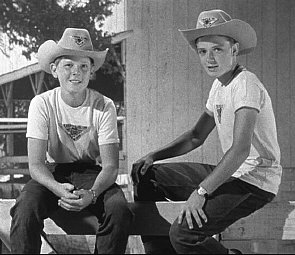
Last night, watching Modern Family with my sister, and her 16 year old son, this week’s episode about the kids surprising the parents in their bedroom with a breakfast tray only to see that they were making whoopee, was a far cry from what was on the air in the 1950s. My nephew joined in the fun, aware as most 16 year olds are – in some fashion – about all those things which were hidden from public discussion in the Eisenhower years, sex above all. In trying to explain the leap between his Junior year in High School and my own, I said, “hey, we watched Spin and Marty.” A staple of the daily “Mickey Mouse Club,” S&M was a show about a rich kid (with a butler) and a non-rich kid at a summer camp for young cowboys. And aside from the Snipe hunt it was pretty tame stuff. Yes, it was a different world, with expectations no less demanding, even if the circumstances we lived in seemed at the time, quite fulsome and lacking in deprivation.

Our biggest worry was that the Russians would figure out a way to fly a plane to Salt Lake, or a rocket and “drop an atom bomb” on us. There were just enough confrontations and bombastic behaviour to give those worries steam. Coming home from school (the 7th grade, I believe ) one day in 1958 my brother greeted me with the information that “we’re almost in a shooting war with the Russians” over Lebanon. It was part of the East-West post WW2 struggle which seemed an almost everyday occurrence. Happily, in most cases it remained on the order of a giant chess game. Pieces were moved around, strategies feigned, yet no single cataclysmic event actually took place, unless you consider the price of a Snickers going from a nickel to a dime cataclysmic. I probably did.

My mom wasn’t a really great cook, but she knew enough dishes to be able to get through a week without duplication, though when the gnarly old broiling pan came out, I knew we were about to be served that most challenging of youthfully eyed dishes, broiled kidneys. You wanna talk uncuttable? Even with a ‘good knife’ there was no way to tear into those puppies. We took our Unicap vitamins every day, drank a glass or two of milk, and on Fridays, especially if dad was home – not on the road selling watches – we’d get steak. The difference being that it was usually one big T-bone for the whole family, and there would be long ongoing discussions about which side of the bone you got. Dad was a master carver, and would always carve the meat in the kitchen, perfectly parallel rows of sirloin on one side and tenderloin on the other, as if cut by a jigsaw. The plaintive cry of my brother and I was that we “never get to cut the meat ourselves.” Maybe that was one of those missing bits of childhood development which would have yielded all the greater “masters of the universe” had we been forced to cut our own steak. We’ll never know.

But the one thing I think I do know is that while it wasn’t a Morton’s porterhouse the size of a small car, that steak was truly more than enough for the family of five. And the fact that we set the big dining table – no ketchup bottle on the table, thank you! and ate like a Rockwell family, seemed to imbue those dinners with something somehow lacking in today’s world. What we have today surely is the banishment of “just enough” as a way of seeing the world. Whether it’s ten million dollar mansions, hundred thousand dollar sedans, or merely the 48 ounce porter house, in so many ways we have too much, given to children too soon, and for far too long. The feelings of entitlement that today’s kids have thrown at them are surely not a fault of their own. The gamesmanship parents play to prove their own offspring somehow superiour does so little to get the children ready for life, that it is at once startling and sad. I know it has become something old hat for my generation to speak longingly of how tough we had it in the fifties and sixties, but with all the simplicity that life handed us we still ended up ok. Today, though, is one of those days when a little reflection might not be a bad thing.

My junior high school (Olympus “… with your flag of white and blue unfurled’ we re proud for all the world to see…”) was typical in that schools built in the 1950s might have had a Public Address system, and a big 16mm projector in the auditorium, but otherwise they lacked anything which we would today consider high tech. So it was, in my 9th grade gym class, on a cold January day fifty years ago (hmmm I guess just writing that number makes me want to go lie down and have a heart attack!) that Don Laursen, the coach, wheeled in a 15” black and white TV to the gymnasium. Once plugged in, we knew it must be something special, since we had never before seen a TV in school. He turned it on and tuned it to Channel 5, the strongest signal in town, and we were informed that we would be watching the Inauguration of the new President. John F Kennedy, (you always pronounced the F if you said his full name) was taking the reins from Ike, and we were there to share in the moment. And there was something transfixing about that phrase “and so my fellow Americans, ask not what your country can do for you…” and the fact that even in very conservative, very Mormon Salt Lake City, we were being treated to the induction of a Democratic president made it a special moment. Just two years later, when I attended Boys State in the summer of 1963 at Utah State University, we ‘Staters rubbed elbows with a bunch of college grads training for the Peace Corps, perhaps the single most idealistic concept this government has ever hatched. It all seemed to come together, and though there were those constant threats of US/Soviet tension, we did seem to feel the world was going to be our oyster.
JFK visits Salt Lake City, Sept 1963
And so today, with electronic news dissemination causing no story to have a life beyond a few minutes, no chance for reflection possible before the next barrage or hailstorm of ‘breaking news’…. Oh wait, Snooki in Florida is breaking news? Well, whatever we call it, it just keeps overwhelming our senses, our ability to think through and digest. The idea of a family of means sharing one nice steak has given way to everyone having way too much, way too soon, and for way too long. I wish there were some way to just slow things down a little. But when I see a Youtube video of a five piece band making music on a subway train using nothing but iPhones, I guess it’s pretty clear that we’re not going back to Spin and Marty. Nonetheless I commend to you, take five minutes and read that Inaugural address. It remains one of the great calls for reasonable behaviour uttered in modern times. In my life I have heard the whisper of Obama in a hall of 20000 supporters, reminding us “yes, we can.” And I suppose that like Kennedy, the reality of governance always strays far from the idealism and principles which got one elected in the first place. But to read Kennedy’s Inaugural address (or listen to it, but reading it yourself is even more powerful) you understand that inspite of all the overbearing difficulties of today’s modern world, merely taking the time to reflect has value. And while this line was written with the Soviets in mind, we would do well to remind all our own elected leaders to take it to heart: “So let us begin anew -- remembering on both sides that civility is not a sign of weakness, and sincerity is always subject to proof. Let us never negotiate out of fear, but let us never fear to negotiate.”

I find it beyond all reason to try and understand how I could have already lived long enough to have events clearly in my mind from fifty years ago. Were this 1961 right now, and my teacher Coach Laursen to have the same wistful memory, we would be talking about January 1911. Life is rolling along too quickly for my taste. Maybe it would slow down the tiniest bit if I could just do a little less, a little slower, and for a just a moment longer. We’re just sayin’….David

Tuesday, January 18, 2011

Gone Phishin'

Last night I dreamt that my mother was back and staying in our old house. (Don’t worry Ro, this is not sad). She was the Rosie whose favorite activities were her service as a volunteer at the hospital, and returning things she had shopped for, probably a day or two prior to the return. “It’s my exercise,” she would say. “I walk the entire mall, at least twice every time I go.” Which may I say, was everyday that she didn’t volunteer at the hospital.

Anyway, I was driving past the old homestead and there she was, on the lawn. “Wow, Mom,” I said. “I thought you were gone.”

She just looked at me and said, “Where would I go?” We made small talk for a while and then she invited me in for tea and Vienna Finger cookies. And in I went.

The house looked different. Well of course it did. Someone else lived there. “Mom, do the new owners know you are staying here? Did you call them? You remember, we sold the house to those nice people who put Christmas lights on the bushes.”

In typical Rosie fashion she said, “Why is it their business. It’s always going to be my house”.

“But Mom, we don’t own it anymore. You remember, you moved to Victoria Mews and then out to Seattle with Jeff and Els?”

“Sure. I remember everything.” Her tone was, ‘what do you think? I am some kind of idiot?’ “But what does that have to do with the price of tea in China?”

At that point, I figured the only thing that made sense was that someone had stolen her identity. (Even when I’m dreaming I need it to make sense. Which reminds me, if anyone gets an email message from me suggesting they: need to go on a diet, buy a cosmetic product, or invest in some ridiculous real estate scheme, please assume I got phished.)

Soon enough, (in dream time), Mom got out all the gold jewelry she pretended was real. “Don’t you think this is all gorgeous.” She was clearly talking to herself. “Costume can be as nice as the real stuff.” Then I knew it was my mother, because she was the single only person west of Brussels who would say something like “this crap is to die for,” and really believe it.

We chatted for a while and when I was ready to leave I asked her if wanted me to give her some money. “Why would you ask that Darling. I’ve always had my own money. Why would I need yours?”

Then, I didn’t know what to do, but I figured honesty was the route to take. “Mom, you died and Jeffrey and I split all your money.”

“You didn’t give any to my grandchildren and great grandchildren? You made me wait long enough to be a grandma. I want them to remember that I took care of them, even if I wasn’t there.” And with that she went back into the house. All I could think about was the new house owners arriving home to find Rosie a permanent part of their lives.
Rose and Jordan Kai, 1989
When I awoke, I realized what the dream was about. Over the last few weeks, we have been talking about what to put on her headstone. The sandblaster thought it should be a duplicate of my dad’s (it’s a double headstone, which always gave me the willies).

“But Mom was her own person, and we know she would want her own inscription.”

“There has to be something in Hebrew,” Melissa, the person in charge of memorials insisted.

“Well, Jeffrey wants the Hebrew portion to say, “I never had duck”. That gave her pause.

“I’m not sure there’s a Hebrew word for duck – maybe poultry.”

“You see,” I explained, “Whenever we went to a Chinese restaurant and had a dish with duck, my Mother always said, ‘I never had duck.’ It’s kind of a family joke.”

“Ok, well we will do whatever you want us to do.” She couldn’t wait to get off the phone.

If you want to know what our final decision was you’ll have to come to the unveiling, but that’s not the reason for the blob. After months of being sad, Jeffrey and I had a fabulous laugh about whether or not there was a Hebrew word for duck. As Mom would have said, “sure, laugh at my expense.” She also would have said I could never be Miss America because I couldn’t smile for the duration of the show. But that’s another blob. We’re just sayin’…. Iris

Friday, January 14, 2011

How Does the King Speak

Before I blob about what I intend to blob about, it occurs to me that Sarah Palin is a dope and we are simply spending too much time comparing her to the President – and other credible public personalities.

If you haven’t seen ”The Kings Speech”, march right down to your local movie theater. It is a remarkable film. And in the realm of “It’s all about me” –which of course, it always is, the story revolves around a soon to be/then King and the speech teacher who taught him how to overcome his stammer. Sounds dry, right? Well, Geoffrey Rush and that adorable Colin Firth are far from dry. Their performances are brilliant, moving, hilarious. So what makes this about me, you ask, because I haven’t given you a clue. Good question, glad you asked.

With much gratitude to my Voice and Articulation Professors at Emerson College – and the number of speech improvement classes we had to take in order to graduate—regardless of major, I was able pay a substantial part of my tuition by tutoring young women who wanted to get rid of their Massachusetts accents and move from secretarial work to management careers. It was fairly lucrative and, although I was never a speech therapist, I was actually capable of helping people with simple voice and articulation problems. There were also a couple of semesters at a Catholic Middle School, where I was hired to teach public speaking in an auditorium size classroom. As you may know, having gone to 6th, 7th, or 8th grade, Middle School kids are incapable of sitting quietly. That was OK by me, because it was a public speaking class. But the Nuns wanted silence and were likely to slap knuckles with a ruler if they heard a sound. Needless to say, my career in Catholic Schools, as well as Middle Schools, was short lived.

If you have seen the film, you know how painful it is to watch someone struggle with a speech problem. And whether the problem is a stutter, or an irritating slushy ‘s’, the person who has the problem, (unless they are in total denial or they use the problem as a tool for attention), is uncomfortable every time they open their mouths.

Throughout my various careers (in politics, academia, entertainment, the corporate and non profit sector-- whew that's tiring), being able to earn some money by teaching people how to improve their speech, has been live saving. But it has also been great fun. My favorite client was Tony Snow, the editor of the “Washington Times”, the conservative Republican newspaper in DC. Tony, who is now a bright star in heaven, didn’t like the sound of his voice and he wanted to transition from pencil to electronic media. A friend of a friend suggested he contact me. Which, despite my politics, he did. Tony had no major problems, just a tight throat and his pitch was a bit high. We could have worked for a couple of weeks and he would have been fine. But we had so many laughs, we worked for six months –maybe more.

Soon after, Tony made the career transition. Every time I heard him on TV or the radio, I felt proud to have been his coach. His work with me was confidential and until this blob, no one knew that he was working on his voice. You may remember that Tony was the Bush 2 Press Secretary (talk painful). But he was also a speechwriter for Bush 1. It was during this time that he called and asked me if I would help the President with his speech problems. I was not prepared to help the Republican President deliver a message. And despite Tony’s convincing argument about the Presidency not being political – I just couldn’t. However, I loved Tony and said if he sent me tapes of the President’s speeches, I would help him to write the speeches in a way that would make it easier for the President to speak. In the case of President Bush one, he had breath control problems, so Tony just needed to write shorter sentences. Every once in a while Tony would call me for a speech “brush up”, and we remained good friends until he died.

When we were watching “The King’s Speech”, it brought back wonderful memories, of working with all those people to be more confident, about themselves and what they wanted to say. And regardless of who they were or where they were professionally, it always made me feel terrific knowing I had been able to help them succeed, even if it was just a little. We’re just sayin. Iris

Sunday, January 09, 2011

Everyone is Saddened

Everyone is saddened by the horrific shooting of Congressman Giffords and the death or injuries to the people who came to meet her or stand by her, while she met her constituents in Arizona. (Sorry Ro, this isn’t going to be happy, maybe tomorrow).

So many questions today, about what kind of a person would do this and why they felt that shooting the Congressman was an answer to solving a problem. And before anyone could answer this question, Sarah Palin aides denied any ill intended public messages sent by the great White Hunter during election season -- despite the fact that the Palin website put a bull's eye on 20 House districts, including Giffords' 8th District in Arizona. The headline read: "We've diagnosed the problem. ... Help us prescribe the solution." The website is no longer online. And with Palin’s expression of sorrow, I’m sure Palin and her people feel absolved of any guilt.

And, maybe she’s neither responsible, at fault, or guilty of any rhetoric or act that encouraged this demented young assassin to think killing a Congressman, who disagreed with him, would solve all the nations problems. Of course, at a time like this there are so many opinions about who should take responsibility for this senseless act of violence. In Washington, they would call it “the blame game”. (I hate that politicians and the media think they have to name every action).

Is is important to get answers to all our questions. Yes, it is. But not at the expense of making reasonable, sensible decisions about how to respond. Yesterday, the pundits were talking about closing the Capital – the People’s house. Why would that make any sense. The shooting happened in Arizona because an elected member of Congress wanted to share ideas. What would make much more sense is closing the mouths of those Congresspeople who do not understand the ramifications of what they say. Am I suggesting we ban freedom of speech. Of course not. I am suggesting that along with their logistical briefings about how to be a Congress man or woman they have a mandatory course in behavior and civility.

Cong. Morris K Udall, also from Tucson, Arizona, was known for his wisdom humor and civility. Two of my favorite Udall quotes are “Lord, give us the wisdom to utter words that are gentle and tender, for tomorrow we may have to eat them.” And “If you can find something everyone agrees on, it's wrong.” OK there is one more … “I have learned the difference between a cactus and a caucus. On a cactus, the pricks are on the outside.” Mo felt that while it was important to recognize the strength and weaknesses of his colleagues, he also understood the need to be collegiate and civil. He was beloved. And when he was in the Veterans Hospital dying, the person who came to visit him every week was John McCain, with whom he agreed about nothing, but still loved and respected his opinions.

Campaign and Election rhetoric has become absolutely unacceptable. The anger, hostility, lies and limited understanding of why and how someone should get elected is disgraceful. Just because a candidate agrees with some campaign advertisement, does not mean it is right or in fact, true. Candidates have become so consumed by the idea of power and the arrogance of “knowing” what’s good for the entire universe, that they no longer have the ability to make reasoned decisions, act for the good of the nation, as well as their constituencies, and operate in a civilized manner. I just don’t think increasing security or blaming one person is going to solve any problems. I think the education of an official as well as their constituency, (even if it takes some time), is the only thing that will make a difference. We're Just Sayin'... Iris

Thursday, January 06, 2011

Coach Mol...

When I talked to Rosalie yesterday I promised her I would write an upbeat happy blob today. So, I am going to try to turn what would ordinarily be a sad story into a happy, happy, contribution.


When I was in seventh grade (and yes I do remember back that far), I had a favorite teacher. He was young, incredibly energetic, and along with being a coach, he taught health. You can only imagine what it must have been like to teach health to a bunch of horny kids, who have no idea why they are horny, but he had a great sense of humor and he hardly ever hung Freddy Boringer on a hook in the front of the classroom. (Don't ask, I was just happy it wasn't my cousin Stevie who spent a great deal of time on the hook, as well.)

Anyway, Coach Mol made us all feel comfortable about bodily functions and cleanliness discussions-- not necessarily at the same time. He showed movies and gave us books and occasionally he would diagram a football or basketball play. It was not an easy time for me because my dad was losing his ability to be mobile and I spent a great deal of time in a rage -- although I didn't know why I was angry at the time. I just was. And for whatever reason, when I was in Coach Mol's class, he made me feel like someone (not in my family) who really cared about me, how I felt, what I thought.

One day we were doing some kind of project which required paper and glue. Someone dumped glue on the floor. The Coach thought it was me. It wasn't. But I thought if I didn't take the blame, Stevie or Freddie would take the blame. So, there I was wiping the floor with a dirty rag and the Coach, trying to be funny, said I wasn't doing a good job. And that's all it took for the rage to return. My pal had betrayed my good deed. "It isn't good enough!" I yelled. And then I threw the gluey rag at him and fled to the girls room. Eventually I came out and there he was waiting at the girls room door. "I didn't do it," I said.

And he said, "I know that now, and I am so sorry kid. Sometimes adults make terrible mistakes, and what's really important is for you to accept my apology -- and never give up your sense of injustice.”

It was a lesson that stuck with me my whole life. You can look for injustice wherever, but never be afraid to admit you are wrong, or to apologize for a mistake.

The coach remained my pal throughout high school. He always called me “kid” and continued to be totally supportive of whatever crazy decisions I made. He was a Marine, and a rare human being. Of late, having been sick for quite sometime, he was living with his daughter in Ohio. I spoke to him right before Christmas. “Kid”, he said, “never lose hope. I am so proud of you and I know that whatever you decide to do, you will always make a difference.”

In the sadness about his loss, I feel comforted that he was surrounded by people who loved him and that he was always spirited and upbeat about life and death.

So Ro, I am sorry I couldn’t be absolutely happy, happy, but having had the benefit of the coach’s wisdom for so many years, I can’t help but smile whenever I think about the person, how centered he was, how he influenced so many lives, and how he loved me despite my politics.

Friday, December 31, 2010

They Call It FUN

Isn’t it amazing how quickly things turn around. Just a few weeks ago most people were talking about how Obama’s chances of more than one term were limited at best. “If he doesn’t do something.” Then, like magic, he did something. He finally did a few somethings. He must have been listening when John Podesta suggested he learn to use the Presidential tools, and additionally, that he needed to be proactive about where he wants the country to go. He needed to say to the Republicans, “don’t vote with me and you will have to tell your constituents why you are not only against human rights, but you have refused to take care of those heroes who risked their lives on 9/11, and are now paying the price with their health.” (If only there were a few more senior staff women to whisper in his male dominated ear, it would have taken a month instead of two years.) Whew, he must have been exhausted. He really needed that Hawaiian vacation. Actually, I could use a Hawaiian vacation. But I’d spend it with the Sullivans and have more fun than the President. It isn’t against the law to have more fun than the President, is it, at least not yet? It is not yet a violation of some new Homeland Security law, is it? No, I don’t think fun is a target for terrorists. Even Janet Napolitano decided to have some fun and go to Afghanistan, which as far as I know is not yet part of the homeland, or for that matter, much fun. And I mean that in the nicest possible way.

But that’s not what I wanted to blob about. Sorry I didn’t write my annual Christmas blob, but the holidays and the writing are not as easy when you can’t call your mother or father, to tell them what a wonderful time you had (wherever you went), and they should have a healthy, prosperous, joy filled new year. Yes, that was a little bit of whining – but it could have been worse. One t-shirt I have says “it could always be worse,” and if it is written on a t-shirt, thus it must be true.
with Joanie in N'burgh
This year we are not celebrating at a party, restaurant or some expensive nightclub. We are staying in. We are in upstate New York, seeing family, checking out old haunts and, having just spent what was an entire wonderful day looking at a variety of properties so perhaps, even finding a place/home for all our worldly belongings.
with Joanie and Kerry...
Isn’t it funny (there’s that word again), that at this time of our lives we are starting from scratch to make a new life for ourselves and whoever else wants to tag along.
if New Years fireworks is your thing, Sydney is your place....
New Years has never been one of my favorite holidays. There’s simply too much pressure to have a good time. This usually means eating and drinking too much and staying up well past a reasonable bedtime just to see if Dick Clark is still standing. Rumor has it that he is breathing but unfortunately not able to stand long enough to do a New Year’ party. Sad, but somehow I will not feel as bad if I get a goodnight’s rest while Snooky, Carson Daly or Ryan Seacrest blather on about the minutes ticking away until the crystal ball falls in Times Square, where, having been there since 3pm, all people want to do is get to a bathroom. (And kiss some loved one or a complete and utter stranger). Other people’s Cooties do not an attraction make.
an actual "fireplace" fire, stoked for New Years
The idea of preparing a great meal with close friends and a beautiful fire sounds like perfection. It will give me time to make and discard a list of New Year’s resolutions. Finish a good book, drink a couple of glasses of fine wine and be thankful for all the good things that happened to me this year (you know who you are), and the new exciting adventures we will have in the year to come. And that includes a great deal of --- yes, Fun. We’re just sayin’…. Iris

Thursday, December 30, 2010

Adios Amigo....

Somewhere in the very late ‘60s, as a budding photojournalist, I began shooting color slide film. Ektachrome, Agfachrome, and Anscochrome were the top films, each processed in a procedure known as E2 (and which later evolved to the current day E6). The film could be turned around in about an hour. The actual mechanics and chemistry were relatively easy if you’d passed a chem lab class in high school, and I even souped a few rolls at the Colorado College Physics Dept. darkroom. But the color wasn’t really true to life, and there always seemed to be a bit of a flatness to it. Simply put, yes, you could shoot a color picture, but along the way you missed a lot of the subtleties of what you were seeing. Photography is really all about light, and how we see it. The way it illuminates a subject, wraps around it, or creates a sheen which gives a scene its personality. My first published color images were of the scene surrounding the launch of Apollo XI, the first mission to land men on the moon. I was living in Miami, and convinced Charlie Jackson (Time’s picture editor) to let me concentrate on the tourists and history buffs who came from all over the country, camped out in their VWs and Mercurys, and waited with excitement to witness the launch of America’s biggest rocket ever. I shot like crazy, along the way partnering up with my French colleague Jean-Pierre Laffont. We photographed the campers, the kids, the square dancers, the lovers on motor cycles, and in the next morning, the hundreds of folks in Titusville who shaded the sun from their eyes to watch the Saturn V rise up into the heavens. It was still the era when processing color film for magazines required several days. The process must seem antiquated by today’s “instant” standards, but involved shooting the pictures, shipping the film to the lab in NYC, having it processed and edited, then “engraved” (like scanning except oh so analogue!) to a plate, which was then used on the press to create the color image. Complicated, difficult, and full of potential technical snafus, but it did let you create a color picture. I was happy beyond belief that I was finally a “Time COLOR” photographer. Yet through it all, as I slowly started to get more assignments in color, I wasn’t very happy with the way the photographs looked. They were never really sharp. The color always had a kind of fogginess, a softness which made me wonder what I was doing wrong.

my first published color pictures: Apollo XI launch (1969)
Somewhere in the search to push myself to a higher strata, I thought I would try the film that had a reputation but which almost no one in the “news magazine” business used, because of the time needed to actually handle the processing. Kodachrome, a film which dated to the 1930s was known to have a more demanding technical side (your exposures had to be bang on!) but when you succeeded, the results were light years beyond the Ektachrome type films. There were only a handful of labs in the world which processed the film – requiring a strange and mysterious set up which only Kodak could supply. The names of the lab locations eventually became little code words for Kodachrome shooters. You didn’t need to specify Kodak: just mention Page Mill (Rd – Palo Alto), Lausanne (Switz.), Fairlawn (NJ), and right away you were in that special realm. The world of the Little Yellow Boxes. In each Kodachrome lab, no matter where it was, the pictures were mounted into red cardboard mounts with the word Kodachrome in red on one side, and the date (month, year) on the other. The boxes were identical, be it Sydney, London, or Fairlawn. We could recognize a Kodachrome box a block away.

The most astonishing thing about opening your first box of Kodachromes was discovering that in fact, your lenses really WERE sharp. Somehow the film was just waiting to etch those images in a way no other film could do. It was just a joy (when you didn’t screw up in the field) to open up and scan quickly through a box just back from the lab.
a fallen martyr- the Iran Revolution (1979)
The original film was an ungodly slow ASA 10. In the fifties that was advanced to 25 as the renamed Kodachrome II became a standard for those seeking the sharpest, richest images. In 1974, rumors of a new version surfaced with the introduction of Kodachrome (KR) 64. At last a film fast enough to shoot almost anywhere, and sharp enough to be just about perfect. The first roll which came my way was in early 1974. I was in Paris and had just photographed the campaign of Valery Giscard d’Estaing, the new French President. I had a quick portrait session with him (yes, typical Burnett window light, thank you!) and included in that shot a roll of head shots done on KR64. A week later one of those frames was the cover of TIME magazine.
boy in Ethiopian refugee camp (1984)
That was about all I needed for convincing. Mindful of the disadvantage that the extra day or two, or sometimes 3 or 4 would cost me in fighting for magazine space, in almost every story I did for the next fifteen years KR would be my film of choice. In the late 80s, Kodachrome 200 was introduced, an amazingly beautiful film that was perfect for sports, and low light level politics. You could shoot that Kodachrome sharpness and tight grain in places were you could barely see WHAT you were photographing. Each was better than the next. It was a gift to those of us who tried to tell the story of the world, and do it with some sense of visual style.
the Outsiders (1982)
Coming back from a two week trip to Ethiopia and Eritrea in 1977, I stopped on the way back from Khartoum at Geneva, and holed up at a swanky Lausanne lake front hotel while the Kodak lab handled my many dozens of rolls. It took two or three extra days, but when I look at those pictures now, and imagine what they would look like on Ektachrome films, I know I made the right call. More than once my film wouldn’t be in contention on a story, simply because while other photographers pictures (done on Ekta) would be dropped into magazine layouts, my film would still be at Kodak being processed. Then, on Friday at noon, just hours before the deadline to send the pictures to the engravers, one or two of my Kodachromes would wander on to the picture editors desk, like a tardy school boy rushing to beat the bell; the richness and sharpness of the images would cause them to make a last minute swap, and my picture would run in the magazine after all. It was always a crap shoot, and one which I am happy I got to roll snake eyes for.
American troops, Grenada (1983)
As digital began to displace film in the late 1990s (and cameras too: the latest and last generation of film cameras, the Nikon F5, the Canon EOS 1 v, the Leica M7) a system which had finally reached the pinnacle of beauty and quality, and efficiency was sacked almost overnight. Thirty five mm film, which had ruled the roost for forty years, was suddenly treated like an outcast, a victim of convenience, and especially of ‘time.’ Editors know that the news is what JUST happened, not what happened yesterday. Film, for all its charms, just couldn’t compete in the world of the breathless 2 minute news cycle. So as with most things worth preserving, Kodachrome was given the ax, tossed under the bus of progress. (Another metaphor awaits, dear reader!)
Couple with cherry pie - Montana (1982)
Truth be told, the last ten or 15 years were not easy for anyone what actually WANTED to shoot KR. Kodak slowly closed labs around the world, and the mere act of getting your film souped became Herculean. (Actually, Hercules shot tri-x.) So when the marketing people at Kodak (this actually happened ten years ago at a dinner in DC) would say that “there is no demand for the film anymore… no one wants to use it..” I had to remind him that at some point anyone using the film -- or any film -- actually wants to be able to SEE WHAT THE HELL THEY SHOT! You can’t expect people to wait a week to see their work. The technology existed to create small mini Kodachrome processing machines which could reasonably be installed at any good sized one-hour lab in the country. But for reasons known only to the geniuses at Kodak’s planning department, no serious consideration was ever given to supporting that project. They sure could have sold a lot of film if only we’d been able to see it in a timely manner. Perhaps it’s a parable for what technology is doing to our society.
Balloon race, Paris (1983)
The need to speed up everything, to be sure that there is no hesitation, no gap between something happening, and its being reported. There is something unfortunate that happens when speed and velocity become the key determinants in a society. Much is lost which requires thought and introspection. We simply rush from the last quickly delivered moment to the next, robbing ourselves of the time it takes to reflect, even briefly about where we are going.
Ethiopian mother and child (1984)

At the time,like most KR shooters, I probably didn't know how lucky I was, but I’m glad I had a chance to live in the last half of the Kodachrome generation. It’s a time that won’t come again. We’re just sayin’….David

Saturday, December 25, 2010

The Last Barbecue...

This is a longer blob than usual, but it’s funny and given our present state of living, I wanted to share it – I think we see a pattern

My original move to Washington DC was somewhat unconventional.
I moved without having a place to live. So I lived, or at least
I slept, in a Fiat 128 station wagon parked in a plethora of
places on the streets surrounding the Capitol. In the morning I
would wake up and make my way to the home of a friend where I
would shower, dress, and go out to look for a job. This went on
for some time until Jane, the person I visited most frequently,
insisted that I spend an entire night at her home. After
spending six months of entire nights at her home I moved to a
rental house which I shared with another close friend. The
landlord was despicable and the arrangement was clearly temporary.
I had moved five times in one year and I was exhausted. I needed
to find a place which was mine. A place where I could belong. A
place in which I would feel secure and permanent and which would
allow me the freedom to repay the kindnesses of lots of friends.

The four story, unfortunately green, limestone townhouse in
somewhat "fashionable" downtown Washington looked like it would be a wonderful place to to live. It was a large Victorian (about 1200 square feet
a floor) charming, airy, and because there was no furniture,
overwhelmingly spacious. Built around 1900 it contained many
turn-of-the-century features: three working fireplaces; the one
in the master bedroom being the most erotic, the others
beautifully carved and totally energy inefficient; 12 foot
ceilings; original wood moldings; a brick patio garden area;
three parking spaces (which in downtown were probably worth as
much as the house); and a front stoop on which one could sit for
endless hours during the summer, fall, part of winter and spring,
peacefully watching all of Washington walk by. I bought it with the help of friends and lived there for nine years.

The house was now for sale. David and I had purchased a
much more managable house in Northern Virginia and we intended to
move within the month. But the Victorian house had been my
friend. It was my salvation during a time when I desperately
needed a place to live. And it became, over the years, a
substitute home for many friends who needed shelter from a bad
situation, or a break from their normal routine. It was a great
space to have a party, or a fundraiser, or any type of
spontaneous diversion. l715 Q Street was used as a home, as a
studio, as a shelter and as a place of business. People always
felt that they could just "drop by" -- and they did, sometimes
for hours, sometimes for months, but that was fine with me because
the visits made for a multitude of memories.

The house held nine years of memories for me, some
exceedingly painful...most very sweet...yet all having to do
with people who were important in my life. It seemed only
fitting that the house host a parting event... and even though
invitations were never extended a few friends just dropped by to
share memories at the last barbecue we would have at the Q
Street house.

John and Susan arrived at 6:30 with a big bag full of fresh
corn on the cob and two large bottles of white wine. Pat and
MaryAnn arrived soon after carrying mounds of magnificent
vegetables with which to make a salad, and two large bottles of
white wine. Mary dropped by on her way back from a California
business trip and, of course, stayed for the evening. At 6:50 she
rushed to the market (which closed at 7:00) to
buy some fish for grilling. She returned with lots of halibut
and two large bottles of white wine.

Despite the fact that evening was developing into quite an
interesting prospect, and I was looking forward to it, I was a
little nervous about the sale and/or rental of the house. That
day we had advertised the availability of the basement apartment
and although we had been inundated with inquiries there were no
prospective rentors on the horizon. Futhermore, that afternoon, the
real estate agent held an open house for prospective buyers and
only two people came to look at it. (Part of the problem was the
realtor's intimidating and clearly inaccurate description of the
house as a Magnificent Mansion.) Actually to say I was a little
nervous is a slightly understated description of my emotional
state. I was a wreck. In fact, by the time Pat and MaryAnn
arrived I was pacing the floor, wringing my hands and obsessing
about the total lack of prospective interest. They, having just
spent endless months selling their house, were most sympathetic.

"It's awful selling a house! How long have you had it on
the market?" Mary Ann inquired with great concern.

"Four days!" I cried back at her. "Do you think I should
lower the price?"

MaryAnn is a sensible person and a mighty good friend who was
now in the process of unloading the vegetables. She simply
paused for a moment, looked at me as if my behavior was perfectly
normal and said, "I'd probably wait just a little longer before I
made any changes."

There had been no indications by any of the crack weather
people in the greater Metropolitan area that there would be a
thunder storm. But just as the coals for barbecuing reached
the absolute perfect temperature, the sky blackened and the rains
came down about as hard as I'd ever seen rains come down. It
should be noted here that in the weeks, months and years prior to
this last barbecue, although the house had been repaired,
reroofed, and reconstructed, it still suffered the symptoms of
old age-- it was never totally sound. There was always a little
something wrong. A dripping faucet, a broken appliance, a new
crack,... always just a little something. Lately the little
something was a strange leak in the ceiling of the country
kitchen/central entertainment area. It was strange because we
had taken what seemed like every possible step to repair the
leak. The roof over the area had been resealed, the bricks over
the area had been reflashed and pointed, the windows on the floor
above the area had been replaced and all the sills had been
reworked. Yet everytime it rained there seemed to be some
leakage. This had two effects: visible new cracks with each
new storm and continued painting of the area once the storm
damage was repaired. In fact, that very morning before the open
house for potential buyers, we had painted a small area that had
been repaired the day before.

The thunder from the storm might as well have come right
through my body as through the sky for it dampened all my visions
of a pleasantly dry evening and an easy sale of the property. My
life in the house flashed before my eyes and I knew that I would
never get rid of it. It would be my albatross. Me and the Q
street house forever bound together by an exceedingly strange
ceiling leak. There was however, only limited time for
"flashing before the eyes".

I raced up the stairs to see what was happening with the
window above the ceiling. The rain was cascading right through
the middle . The rain was coming in between the inside window
and the newly replaced storm window. It was as if there were no
window at all. And then I heard the dreaded words... "It"s
coming through the ceiling!"

I raced back down the stairs. David, my husband, my love ,
the man with whom I will spend the rest of my life, was
struggling to get a large ladder out of a small closet... he was
not pleased and was not his usual objective self. The phone
rang. It was Paula and Arthur who couldn't be with us because
Arthur's parents were spending the weekend.

"Hi", Paula said cheerfully. "Can you believe this weather?
It's so awful we're not even going to drive to the country for
dinner. What's going on over there?"

"P, " I answered, "It would be impossible to describe to you
exactly what is going on here, but if you want a few laughs put
the parents in the car and stop by here for just a glimpse of the
activity."

"Sounds interesting but we have to find somewhere to feed
the folks so we won't have the time to drop by--but send our
love, see you, bye."

I raced back up the stairs, ripped through the boxes I had
carefully packed for the move and located some towels which I
immediately stuffed into the middle of the window to impede the
entry of any more water.

I raced back down the stairs to see if it had worked. Pat
was now up on the incredibly shakey ladder trying to dry the
wall. John was holding the ladder to prevent any further rain
related disaster. Mary was running back and forth into the
kitchen exchanging wet towels for dry. MaryAnn was watching to
make sure the fire for grilling did not go out (We had no more
charcoal and the stores anywhere within reason were closed).
Susan was busily shucking corn. And David who had obviously
succeeded in removing the ladder from the closet had decided that
the most useful thing he could do was refill the wine glasses.
The phone rang. It was Chuck. He couldn't be there because he
was entertaining his kids for dinner.

"Hi, is it raining as hard there as it is here?” he asked,
hoping the answer was no. Chuck, having participated in the
repair and painting knew only too well what a heavy rain could
do.

"Yes" I said (exhaling the sound to indicate frustration.)

"Well don't worry, we still have enough paint for two more
storms. Gotta go but I'll speak to you tomorrow." He hung up.

I raced back up stairs to see if the window towels were
helping. They were not.

I raced back down the stairs to see if there was anything
I could do to help in the drying effort. Mary was now on the
ladder, Pat was holding, MaryAnn was exchanging wet towels for
dry, Susan was watching the fire and John was shucking corn,
David was still pouring wine. It seemed there was only one thing
I could do... grill the fish. Yes there was a torrential
downpour and yes I was going to get wet to the point where I
thought I would never dry, but I needed to do something. We were
all getting hungry, the fish needed to be grilled, and cooking
was the only way I knew to control my hysteria... so I grilled
the fish while Mary and Pat switched off on the ladder in a
ongoing attempt to dry the wall, John and Susan switched off or
shucked simultaneously, MaryAnn made the salad and David, while
pouring the much needed wine remarked, "Gee the leak would have
been boring if our friends hadn't been here!"

Eventually, the force of the rain diminished with the chaos
of the wall drying/dinner preparation and my anxieties.
The fish was grilled, the salad was no longer separate vegetable
entities, and the corn had shed its final shuck. We gathered
around a rectangular shaped glass coffee table (which was always
used in lieu of a dining room table) and we sat on the floor with
our dinner plates on our laps. Dinner was warm, dry and
delicious. We sat in comfortable positions on pillows that were
mushed to sitting perfection. We spoke of the places we loved
most, the geography we thought most beautiful, and our favorite
things to eat. We laughed about what it was like, as
adolescents, to buy prophylactics or have a first period.

We shared a melange of stories and secrets about ourselves
and our friends. The phone rand continuously. Mel and David
called from the coast just to say hello. Jane called from
Africa. Nikki called from Virginia. Carolyn called from Capitol
Hill and Louise called from up the street. It was as if all the
voices of the past and present knew that there was only a little
time left to have contact with an era about to end. We missed the
people who belonged at the barbecue but couldn't be there. In
their honor we tried to remember all the times we had spent
together having fun. And then we spoke joyously of the adventures
we would share in the future.

That evening was a flawless reflection of what my life had
been in that house. A continuing mixture of joy, sorrow,
frustration, love, and shared secrets.

The last barbecue most certainly reconfirmed David's
perception of the evening. Situations are less boring when you
share them with friends. What a fitting finale for a perfect
beginning. We’re just sayin’…. Iris

Thursday, December 16, 2010

1915 North Upton St.


It happened so quickly that we didn’t even have a chance to tell everyone about it. We sold our house and moved all our worldly possessions into storage. We are now staying at 220 E 54th St apt 3J, NY 10022. And can be reached at PO Box 69, NY 10150. Of course 1915 was more than a house and more than a home. It was a workplace, a theater, a peaceful refuge for people who needed comforting, a home for wayward political volunteers, a place we celebrated holidays, (the New Year, Super Bowl, Hannukah), where we thrived because we were surrounded (at the drop of a hat), by enthusiastic teenagers. It was an office, a studio, a playground, a place to strategize about world policies, and a place to entertain so many people we loved. You never knew who you would find when you opened the door. It might be a political reporter or editorial cartoonist, a chef, photojournalist, White House photographer or staffer, (yes, there is a difference – the ‘credential’), elected official, lobbyist, movie, tv or theater celebrity (once I came home and found Anna Deavere Smith interviewing David), corporate executive, musician, composer, felon, butcher, baker, and an occasional Indian diplomat or someone of special note – (for us these folks were always friends and family -- sometimes that was synonymous.) The purpose of sharing this information is not to brag, but simply to explain, 1915 was an interesting place to be.

In addition to all these things, it was the place where my son told me he thought he had sex (he wanted me to decide if this was so), he found his first pimple, and he learned to skate board. It was also the place my daughter was born, grew up, and found her professional calling. Oh, you know I could go on and on (as I often do), but you get the point. In fact, chances are, you were probably around helping us make a memory.
...the office...
Over the years it became a place where you went to laugh about the state of the world, or cry about the loss of a friend. We couldn’t dawdle with a long, maudlin, drawn out goodbyes (The new owners wanted to show their son his new room, and their painters were showing up an hour and a half after ‘closing.’) We simply left the way we came. David taking pictures and I, begging him not to take any of me. Yesterday we said our final goodbyes to our incredible neighbors (these were the kind of people who pumped out the flood in our basement when we were away, and with whom we often gathered on the street for an impromptu “Upton Street” cocktail party.) They had a lovely dinner in our honor, and to the life we lived amidst them for twenty five years. We pasted a picture of ourselves in a hidden place where it would never be found, bid adieu the way Jordan did before she left for school each morning.
the hidden polaroid, ca. 1990
We simply said “Goodbye, my house, goodbye, my tree,” looked both ways before we crossed the street, got in the car and drove away. We’re just sayin’….Iris

Sunday, December 12, 2010

A Different Sort of Tragedy

There were two tragic politically related events this week. The saddest of the two was the passing of Elizabeth Edwards. I’ll get back to the other in a bit. Elizabeth Edwards was among many other things (writer political wife, educator, activist), an inspiration. There are people who loved her unwavering support for her husband and the issues about which they cared so deeply. There was absolutely no one who didn’t identify with her pain when she talked about the death of her son. There was absolutely no one who could escape the pain of her announcement about her incurable breast cancer. And there was no one who could escape the pain of her humiliation when she responded to her husband’s betrayal. And although pain can be inspirational, it was not what I found inspirational. It was, what appeared to be an indefatigable strength to keep moving forward. Some pals have said that overcoming difficult times makes one a better person. It might be true – although I don’t need any more hard times because, as you all know, I am wonderful enough. But enough about me …. (never). Elizabeth was, (as a public persona), gutsy, brave, optimistic, and as her daughter said today, comforting. While we might have been able to identify with all her losses, and humiliations she suffered, there are very few of us who could have been as graceful and courageous about it. Can you even imagine what it must have been like for her to have to deal not only with impending health disasters, but with children who knew that there father had done something unforgivable to their mother. So unforgivable that he would not be permitted to live with them anymore. So many losses, and so much determination to go on with whatever life she had left to live. It was not necessary to be Elizabeth’s friend to know that she was a person with a generous and loving spirit. And it was not necessary to be at the funeral to know that the loss of Elizabeth will be felt by people well beyond her immediate family.

The second tragedy was of a totally different nature and falls into the category of, “what could he possibly be thinking”? Who in their political right mind would say, “I have to go to a Christmas party but President Clinton will stay in the press room and take questions.” The tragedy here was that the President allowed himself to be compared with Bill Clinton – in the White House. President Obama is very smart and quite articulate, but he is not Bill Clinton – No one ever could be. No one can compare with Bill Clinton in dealing with impromptu questions from the press or the public. There is no question that Clinton did exactly what Obama and his advisors asked him to do. Of course he did. He supported the President’s tax compromise and explained, as no one else could, how important it was for the Democrats to support it as well. But what more do you need to know than that President Obama went to a Christmas party and President Clinton stayed with the media, to clean up the mess. The thing that always amazed me about Bill Clinton was that he liked people. There were never too many hands or enough time to shake them. It’s why he was always late. He hated to leave an event without talking to every person in the room. The thing that amazes me about President Obama, is that he doesn’t seem to like people. Well, maybe he likes them in the greater sense, but in one on one situations, he seems uncomfortable and always seems to have one foot out the door. ( I wonder how long he stayed at the Christmas Party). I have heard that the first couple no longer takes individual pictures with their guests. One tragedy is that never would have happened in any previous White House. Are there other tragedies as well? Yes, there are. But I won’t go on and on. Suffice to say that at a time when the President should be demonstrating what it means to lead, he led a different President to the podium and he went to a party. We’re just sayin’…. Iris

Wednesday, December 08, 2010

The Road Not Taken

During the last few weeks I have preferred to write about my moving woes instead of anything substantive. It’s been hard to think beyond what to do with all our worldly possessions. But with the President’s decision to give tax breaks to the richest 2% of the populace, in order to get an extension of unemployment compensation for hardworking Americans who, because of a lousy economy, lost their jobs, life savings, (and in many instances, homes), I could no longer remain silent or as others might describe it, consumed with self.

The whole political ‘landscape’ needs a good paint job. Congress is not only ineffective but, some would agree, has dangerously limited vision. In lieu of making their constituents a priority, they are playing political games with constituents lives. And the professor/community organizer in Chief, just wants to be friends with people who want to destroy him. I would suggest, the first thing the President and his merry band of advisors (including Geithner – who did not go to jail for doing the same thing they convicted Wesley Snipes of doing -- only Snipes is supposed to serve 36 months) needs to do, is watch some old episodes of “The West Wing”. He needs to take a few lessons in leadership and Congressional diplomacy (a good kick in the ass), from Jed Bartlett, the President many of us expected Obama to be.

A few years ago, John Spencer, a friend, fine actor and terrific Chief of Staff on the “West Wing”, came over to our house (the one we no longer own), for a barbeque. We invited assorted Washington types with whom he could mix and mingle. At one point he asked us if we thought “The West Wing” was a accurate portrayal of the way things work in Washington. Almost without exception, (our pal Janice from Salt Lake City who admittedly didn’t know about the way Washington works, she also didn’t know who John Spencer was), it was agreed that the reason we loved the show was because it was not accurate, but it was the way we wanted things to be. My guess is that a great many people thought the same thing. The nation was so excited about the possibility of some real change in the way Washington worked, that they thought a “West Wing” like the one Hollywood produced was a real possibility.

My guess is that there are a great many Republicans, as well as Democrats out of work. It is just possible that not all Republicans are rich and not all Democrats are middle class. If the President had addressed the nation and said that he would not allow the Republican Congress to cut off an extension of unemployment compensation in order to add another 80 billion dollars to the deficit, so the 2% of the richest people in the nation could enrich themselves a bit more, the public would have supported his position. But it is impossible to support a position that turns out not to be a position – just more rhetoric.

When I listen to what people say about Obama lately, it always starts with “I like the guy, but….” Exactly what do they like about him, I wonder. He seems to be a good father, and husband. He is handsome, personable and articulate. He has good taste in clothes, and plays a mean game of basketball. Those are all likeable qualities. But where is the man we elected to get us out of a war, make certain human rights were respected in our military (where the war still goes on). Makes employment for everyone who wants to work, the national priority. And demonstrates an ability to lead rather than compromise, when it comes to making a positive difference for the majority of our citizens.

For those of us who know all too well, the way Washington works, being nice to, rather than merely respectful of, the opposition’s demands, is a terrible waste of time. People want leaders to lead. To have a strong voice and clearly defined positions. Even if we don’t agree with that voice or position, we would feel comforted by the idea that there was a leader who knew in what direction he wanted the country to go. If you look like you know where you are going, people will follow. If you change direction and seem confused about the path you should follow, people will eventually lose confidence in your ability to choose a path. It’s not so much about the ‘road less taken’ as it is about keeping a sharp eye on whichever road you choose, and making damned sure you keep the end of the road in sight. We’re just sayin’… Iris